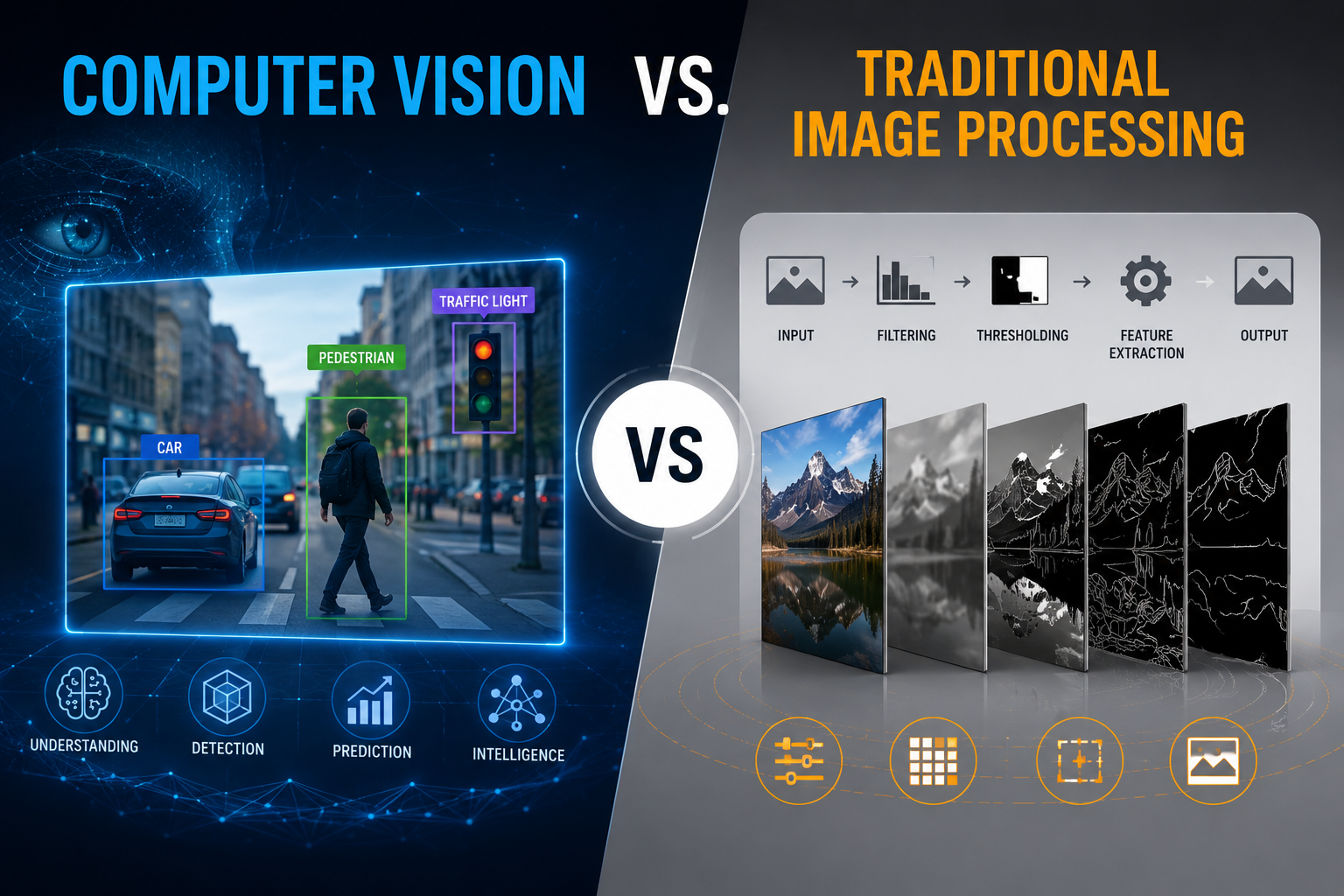
Traditional image processing applies fixed, human-written rules (filters, thresholds, edge detection) to transform or clean up an image — it never “understands” what’s in the picture. Computer vision uses machine learning, usually deep neural networks, to interpret an image the way a human would: identifying objects, faces, defects, or patterns and making decisions based on what it sees. In short, image processing manipulates pixels; computer vision interprets meaning.
If you’ve ever typed “computer vision vs image processing” into Google, you’ve probably landed on explanations that get lost in academic jargon. This guide breaks it down in plain business terms — what each technology actually does, where the line between them blurs, and how to know which one your project actually needs.
What Is Traditional Image Processing?
Image processing is the older, rules-based discipline. A developer writes explicit instructions — mathematical operations applied uniformly to every pixel — to enhance, transform, or extract basic features from an image.
Common image processing operations include:
- Filtering — blurring, sharpening, or noise reduction
- Edge detection — highlighting boundaries using algorithms like Canny or Sobel
- Thresholding — converting an image to black and white based on pixel intensity
- Histogram equalization — improving contrast in poorly lit images
- Geometric transformation — resizing, rotating, or cropping
These operations are deterministic. The same input image always produces the same output, and the system has no concept of what it’s looking at — it simply follows the rules it was given. A thresholding script doesn’t know it’s looking at a car versus a cardboard box; it only sees pixel brightness values.
What Is Computer Vision?
Computer vision is a subfield of artificial intelligence that trains models — most commonly convolutional neural networks (CNNs) or vision transformers — on large datasets of labeled images. Instead of following fixed rules, the model learns statistical patterns that let it generalize to new, unseen images.
This is what allows computer vision systems to:
- Detect and classify objects it has never seen in that exact form before
- Track people or vehicles across multiple video frames in real time
- Recognize faces for secure, frictionless access control
- Flag subtle defects on a production line that a rules-based filter would miss
- Read and digitize text from messy, real-world documents (OCR)
- Assist radiologists by spotting irregularities in medical scans
The key difference is generalization. A traditional image-processing script has to be manually reprogrammed for every new scenario. A trained computer vision model adapts to variation — different lighting, angles, occlusion, or product batches — because it learned underlying patterns rather than a fixed formula.
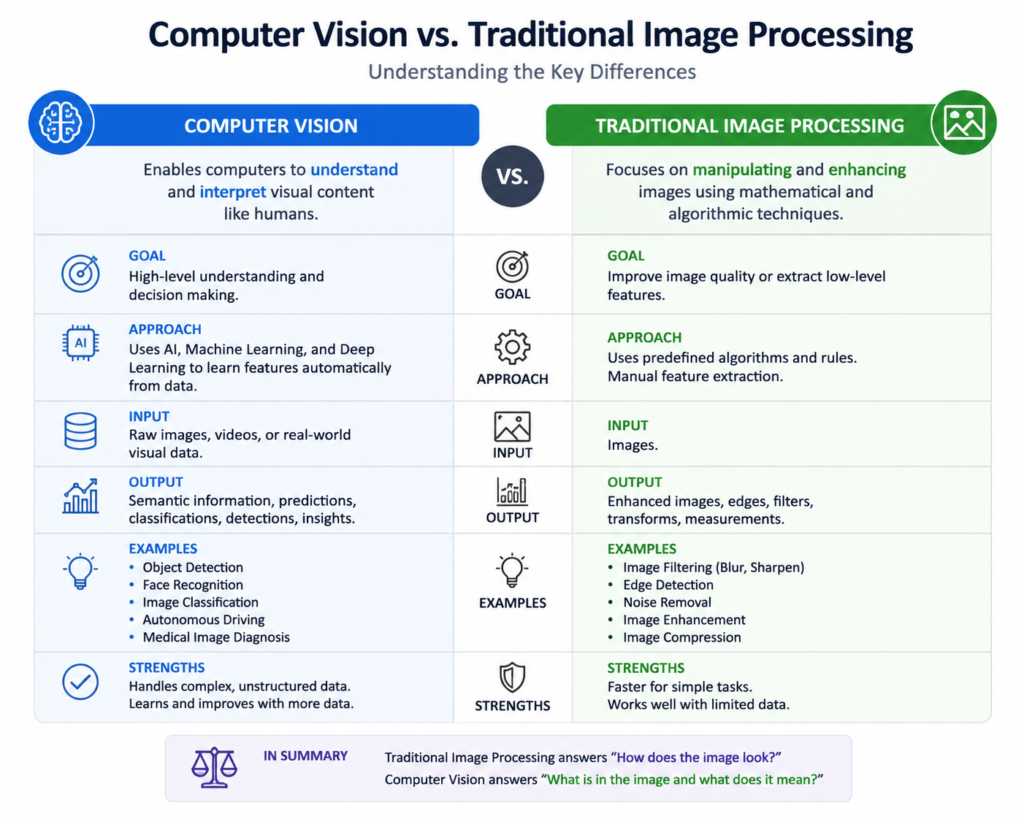
Computer Vision vs. Traditional Image Processing: Side-by-Side Comparison
| Aspect | Traditional Image Processing | Computer Vision |
|---|---|---|
| Core method | Fixed mathematical rules and filters | Machine learning models trained on labeled data |
| Understanding | No semantic understanding of content | Interprets objects, patterns, and context |
| Adaptability | Must be manually reprogrammed for new cases | Generalizes to new, unseen scenarios |
| Typical tasks | Blurring, edge detection, cropping, contrast fixes | Object detection, facial recognition, defect classification |
| Data requirement | None — works on any image | Needs large, labeled training datasets |
| Accuracy on complex scenes | Limited, breaks down with variation | High, even in unpredictable real-world conditions |
| Real-time decision-making | Not designed for it | Built for it (tracking, alerts, automated actions) |
| Example | Sharpening a scanned document | Detecting a missing screw on an assembly line |
Do You Actually Need Computer Vision, or Just Image Processing?
Not every visual problem needs a deep learning model. In fact, most production computer vision systems still use traditional image processing as a preprocessing step — cleaning, resizing, or normalizing images before they’re fed into an AI model.
Traditional image processing is usually enough when:
- The task is simple and highly repeatable (e.g., resizing product photos)
- Conditions are fully controlled (fixed lighting, fixed camera angle, fixed background)
- There’s no need to identify or classify what’s in the image — only to transform it
You need computer vision when:
- The system has to make a judgment call (Is this a defect? Is this the authorized person? Is this product mislabeled?)
- Conditions vary — different lighting, angles, occlusion, or object orientation
- You’re processing high volumes of images or live video streams and need real-time decisions
- Accuracy directly affects safety, compliance, or revenue
Where the Two Technologies Work Together
In practice, the strongest visual AI systems don’t choose one over the other — they combine both. A typical production computer vision pipeline looks like this:
- Preprocessing (image processing) — normalize lighting, remove noise, crop the region of interest
- Inference (computer vision) — a trained CNN or vision transformer analyzes the cleaned image and makes a prediction
- Post-processing (image processing) — draw bounding boxes, overlay labels, or trigger an automated action based on the model’s output
This hybrid approach is exactly how enterprise-grade systems achieve both speed and accuracy — image processing keeps the pipeline efficient, while computer vision provides the intelligence.
Real-World Applications Where Computer Vision Outperforms Traditional Methods
- Manufacturing quality control — spotting micro-defects across thousands of units per hour, even with lighting inconsistencies
- Retail & inventory management — recognizing products on shelves regardless of angle, packaging changes, or occlusion
- Healthcare diagnostics — identifying irregularities in medical imaging that rules-based filters simply cannot classify
- Security & surveillance — tracking people or vehicles across multiple live camera feeds in real time
- Logistics & autonomous systems — detecting obstacles, reading signage, and making navigation decisions on the fly
- Document digitization (OCR) — extracting accurate text from inconsistent fonts, handwriting, or damaged scans
These are precisely the scenarios where fixed-rule image processing breaks down — and where a properly trained computer vision model becomes a business necessity rather than a nice-to-have.
Final Takeaway
Traditional image processing and computer vision aren’t competitors — they’re different tools for different problems. Image processing is fast, predictable, and perfect for controlled, repetitive transformations. Computer vision is what you need when a system has to actually understand what it’s looking at and make a decision in real time, across constantly changing real-world conditions.
If your business is still relying on manual visual inspection — or on rigid, rules-based scripts that break every time conditions change — that’s usually the clearest sign it’s time to move to a trained computer vision system. Deutics designs and deploys custom computer vision solutions for quality control, object detection, facial recognition, medical imaging, and OCR, built around your specific environment and data.
Frequently Asked Questions
1. Is computer vision the same as image processing? No. Image processing applies fixed rules to transform pixels, while computer vision uses trained AI models to interpret and understand what’s actually in an image, such as objects, faces, or defects.
2. Which is faster, computer vision or traditional image processing? Traditional image processing is typically faster for simple transformations since it involves fixed calculations. Computer vision requires more computing power for inference, but modern GPUs and edge devices allow it to run in real time even for video streams.
3. Can a business use both computer vision and image processing together? Yes, and most production systems do. Image processing is commonly used to clean and prepare images before a computer vision model analyzes them, combining speed with intelligent decision-making.
4. Does computer vision require a lot of training data? Generally, yes. Computer vision models need a labeled dataset representative of the real-world conditions they’ll operate in. The more variation in lighting, angles, and object types, the more data is typically needed for reliable accuracy.
5. What industries benefit most from computer vision over traditional image processing? Manufacturing, healthcare, retail, logistics, and security see the biggest impact, since these industries deal with variable, real-world visual conditions where fixed-rule image processing alone cannot deliver reliable accuracy.